Dsp Architecture By Avtar Singh Solution Manual
From India to U.S.A. About this Item: Brooke Cole/Cengage Learning India, 2004. Condition: New.
First edition. Bridging the gap between Digital Signal Processing theory and design, this implementation-oriented textbook is based on the authors` extensive experience in teaching graduate and undergraduate courses on the subject. The objective of the book is to help students understand the architecture, programming, and interfacing of commercially available programmable DSP devices, and to effectively use them in system implementations. Throughout the book, the authors utilize a popular family of DSP devices, viz., TMS320C54xx from Texas Instruments. In the end, students will be comfortable in using both hardware and software for designing with the programmable DSP devices.
Contents: INTRODUCTION. A Digital Signal Processing System.
At89c2051 programming software. A byte to be programmed or read back is sent/received through P1. The circuit may be built using simple point-to-point soldering with a general purpose PCB( fish's egg like PCB) or making PCB shown above, the file is Protel PCB version 2.76. Incrementing address is done by pulsing a positive pulse to XTAL pin.
Programmable Digital Signal Processors. Major Features of Programmable Digital Signal Processors.
DSP Processors and Architectures – Download as PDF File.pdf), Text File.txt) or using DSP microprocessor with Examples from TMS32C54XX (Avtar Singh. The Architecture of TMSC54xx Digital Signal Processors. Avtar Singh is Professor of Electrical Engineering at San Jose State University. Earlier he taught.
The Scope of the Book. INTRODUCTION TO DIGITAL SIGNAL PROCESSING. A Digital Signal Processing System. The Sampling Process.
Discrete Time Sequences. Discrete Fourier Transform (DFT) and Fast Fourier Transform (FFT). Linear Time Invariant Systems. Digital Filters. Decimation and Interpolation. Analysis and Design Tool for DSP Systems?MATLAB.
Digital Signal Processing using MATLAM. COMPUTATIONAL ACCURACY IN DSP IMPLEMENTATIONS. Number-Formats for Representation of Signals and Coefficients in DSP Structures.
Dynamic Range and Precision. Sources of Errors in a DSP Implementation. A/D Conversion Errors.
DSP Computational Errors. D/A Conversion Errors. ARCHITECTURES FOR PROGRAMMABLE DIGITAL SIGNAL PROCESSING DEVICES. Basic Architectural Features. Computational Building Blocks. Bus Architecture and Memory. Data Addressing Capabilities.
Address Generation Unit. Programmability and Program Execution. Speed Issues.
Features for External Interfacing. PROGRAMMABLE DIGITAL SIGNAL PROCESSORS. Commercial Digital Signal Processing Devices. The Architecture of TMS320C54xx Digital Signal Processors. Addressing Modes of the TMS320C54xx Processors.
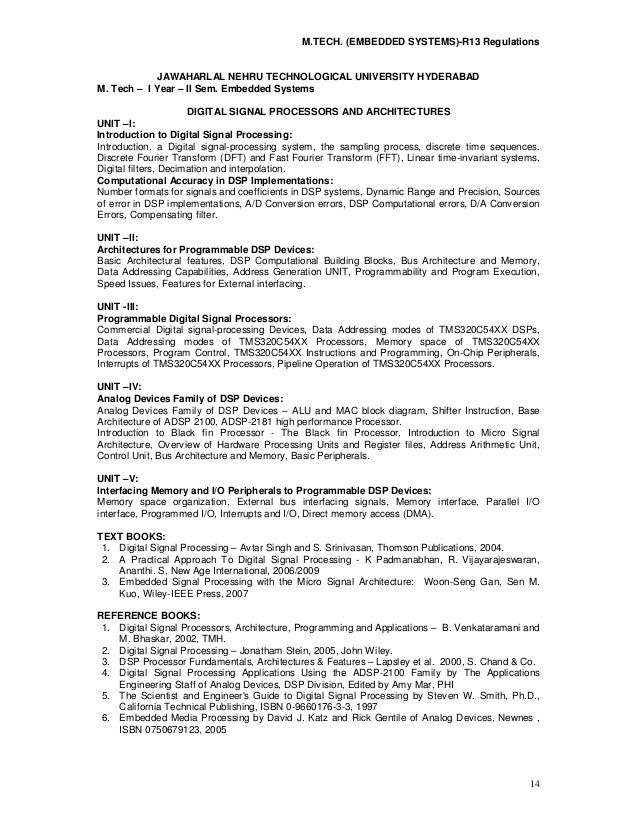

Memory Spaces of TMS320C54xx Processors. Program Control. TMS320C54xx Instructions and Programming. On-Chip Peripherals.
Pipeline Operation of the TMS320C54xx Processors. DEVELOPMENT TOOLS FOR DIGITAL SIGNAL PROCESSING IMPLEMENTATIONS.
The DSP Development Tools. The DSP System Design Kit (DSK). Software for Development. The Assembler and the Assembly Source File. The Linker and Memory Allocation. The C Compiler. The Code Composer Studio.
DSP Software Development Example. IMPLEMENTATIONS OF BASIC DSP ALGORITHMS.
The Q-notation. Interpolation Filters. Decimation Filters. PID Controller.
Adaptive Filters. 2-D Signal Processing. IMPLEMENTATION OF FFT ALGORITHMS. An FFT Algorithm for DFT Computation. A Butterfly Computation.
Overflow and Scaling. Bit-Reversed Index Generation. An 8-point FFT Implementation of TMS320C54xx. Computation of Signal Spectrum. INTERFACING MEMORY AND PARALLEL I/O PERIPHERALS TO PROGRAMMABLE DSP DEVICES. Memory Space Organization of the TMS320C54xx Devices.